Podcast: Play in new window | Download (Duration: 57:25 — 83.6MB)
Subscribe: Spotify | Pandora | iHeartRadio | Email | TuneIn | Deezer | RSS | More
Time Management Is a Myth: 5 Rules to Own Your Focus
Here’s the truth nobody selling planners wants you to hear: time management doesn’t work, because you can’t manage time.
Time is outside of you. It doesn’t care whether you run a company, lead a sales team, coach athletes, or are trying to get your kids to practice on time. Everyone gets the same 1,440 minutes a day. Nobody gets more, and nobody owns them.
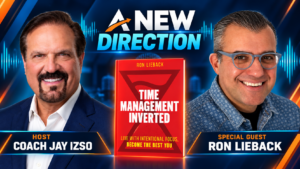
On this episode of A New Direction with Coach Jay Izso, I sat down with Ron Lieback, author of Time Management Inverted: Live with Intentional Focus, Become the Best You. His core idea changes how you look at your day: you don’t own your time, but you do own your focus. When you start managing focus instead of time, you do better work in less time, with less stress, and you have more of your life left over to enjoy.
Here are five rules from Ron’s framework that apply to anyone: a business, a team, or just you.
Rule #1: Stop Trying to Manage Time. Manage Your Focus.
Ron writes that time is a perception, and our emotions control it. As a psychologist, I can confirm it. Ten minutes in the dentist’s chair feels like an hour. Three hours doing what you love disappear.
So the real time management question isn’t “How do I get more time?” It’s “Where is my focus going?” For most of us, the answer is somewhere we never chose:
- The average American spends 4 hours and 37 minutes a day on their phone. That’s about 70 days a year.
- Boston Consulting Group found the average worker loses nearly 30% of their productive time to digital distractions.
- Once you’re pulled off task, it takes at least 20 minutes to fully get back.
- Our minds wander 47% of the day, according to Hyperfocus author Chris Bailey.
You don’t have a time problem. You have a focus leak.
Rule #2: Flip the Pyramid and Start With Your Grand Vision
Most time management systems start with a to-do list. Ron’s TMI (Time Management Inverted) framework starts at the top with your Grand Vision, the big result you’re after. That might be building a business, winning a championship, getting healthy, or running a marathon.
From there the pyramid narrows:
- Grand Vision: the big goal, usually on a one-year horizon
- Realignments: planned room to pivot
- Monthly goals: milestones that support the vision
- Weekly tactics: the actions that build momentum
- Daily tasks: the intentional focus that makes it all happen
Ron also recommends setting a Grand Vision in each area of your life: health, relationships, business, and finances. His test for whether one is worth chasing: Is it so meaningful I’ll remember it on my deathbed?
The piece I love is realignment. When a plan stops working, most people either quit or push ahead on blind optimism. Ron says “100% optimism isn’t possible. Or wise.” You stop, figure out what went wrong, and adjust. I teach the people I coach to treat life as an experiment. A result you didn’t want isn’t a failure. It’s data. Clean up the variable and run it again.
Rule #3: Focus on No More Than 3 to 5 Things
This is the heart of the framework, the BIG 3-5. At every level (monthly, weekly, daily), you focus on three to five priorities. Never more. Past five, the mind loses concentration and the work gets sloppy. For daily tasks, Ron says three is plenty.
To make it stick:
- Plan your week before it starts, Sunday night or Monday morning.
- Leave buffer time. Something unexpected will always show up.
- Do a Friday review. Ask three questions: What went well? What didn’t? How should I pivot next week?
- Try the time compression test. If you only had four hours a day starting tomorrow, what would you focus on, and what would you cut?
You can’t cheat the harvest. Three focused tasks done every day will beat twenty half-finished ones, whether you’re in a boardroom or a locker room.
Rule #4: Protect Your Focus. Every Yes Has a Hidden Tax.
Ron uses a term everyone should borrow: Creative Units (CUs). At 100 CUs your energy is fully charged and your best work comes faster. Near zero, everything takes longer and what you produce is forgettable.
The biggest drain isn’t the clock. It’s overcommitment. Every yes comes with a hidden creative tax. Every “quick call,” every “got a minute?”, and every obligation you didn’t need to take on draws from a limited supply of mental energy.
Warren Buffett said the difference between successful people and really successful people is that really successful people say no to almost everything.
To keep your focus sharp:
- Do your most demanding work during your peak energy hours
- Save the busywork (email, errands, admin) for lower-energy windows
- Track your energy for a few weeks to find your own peak, because there’s no one-size-fits-all time
- Brain-dump daily. Get unfinished thoughts onto paper so they stop taking up space in your head
Rule #5: Unplug Completely and Enforce Downtime
This is the rule driven people resist most: the belief that more hours equals more productivity needs to end. Ron points to the burnout, broken relationships, and unhealthy habits that come from being “always on.” I’ve seen it with executives, and I’ve seen it with young athletes who never get to rest.
His answer is a cold turkey digital detox. No social media, no texts, no email, no calls during focused time. Start with a few hours a day, work up to a full evening, then a full day on the weekend. The rule that matters: when you’re off, stay off.
Pair that with enforced downtime: short breaks every day, longer ones every week, and real time alone. Ron also points to what Chris Bailey calls “scatter focus,” letting your mind wander on purpose, which helps you recharge, plan, and come up with fresh ideas.
If you can stay fully focused for even two hours a day, you’ll get better results with less stress, and you’ll actually enjoy your time away.
The Bottom Line on Time Management
Real time management isn’t about cramming more into your calendar. It’s about deciding where your focus goes, protecting your energy, and saying no to everything that doesn’t serve your Grand Vision.
Ron closes Time Management Inverted with a line worth taping to your mirror: Don’t settle for average. Ever!
Frequently Asked Questions
What is Time Management Inverted?
It’s Ron Lieback’s framework, built as an upside-down pyramid: Grand Vision, realignments, monthly goals, weekly tactics, and daily tasks, with only 3 to 5 priorities at each level.
Why doesn’t traditional time management work?
Because time is outside your control. Focus isn’t. When you manage your focus, what you do with your time changes, and so do your results.
How many things should I focus on each day?
Three to five, and Ron says three is plenty. Past five, concentration and quality drop.
How do I start a digital detox?
Start small. Block a few distraction-free hours each day and stay fully offline during them. Then build up to a full evening and a full weekend day.
🎧 Watch or listen to the full episode of A New Direction with Coach Jay Izso with Ron Lieback on YouTube or wherever you get your podcasts, and grab a copy of Time Management Inverted: Live with Intentional Focus, Become the Best You.
Ron Lieback’s book, Time Management Inverted: Live with Intentional Focus, Become the Best You is an absolute eye opening read. Like many of you are probably thinking, “Oh great it’s another ‘time management’ book…you would be wrong. This isn’t about time management this is about reaching the goals you set through managing your focus.
I read this book twice. The concepts are not difficult, but there is an internal resistance to doing them. Why? Because we have been taught the wrong thing for years when it comes to achieving our “Grand Vision” that the majority of us never achieve it. This book changes that. It challenges you in ways you may not be prepared for but the Time Management Inverted (TMI) framework process works. Because you focus on the process, not the results. The results take care of themselves.
This book is practical. Every chapter ends with a summary and steps that you can take immediately. And he even provides AI prompts to help you think about what you are doing when it comes to achieving your “Grand Vision” in a slightly different way.
Are you looking for greater success? Do you want to eliminate your bad habits? Are you ready to be more productive in less time? Do you want to achieve greater things? Then Time Management Inverted: Live with Intentional Focus, Become the Best You is for you.
Get your copy of Time Management Inverted: Live with Intentional Focus, Become the Best You by Clicking on the link.
Please reach out and say thank you to the financial partners of A New Direction Show:
L inda Craft Team, Realtors® for more than 40 years they have helped 1000’s of people make a smooth transition when it comes to buying and selling real estate.
A boutique firm with a global reach. Unaffiliated with any national or international brand, Linda Craft Team, REALTORS® is recognized as one of the leaders when it comes to residential real estate.
Being unaffiliated is an advantage for you! Because if you need a referral in your area, you can be confident knowing that her recommendations do not come from within some international or national affiliate, but because she has connected with that absolute best agent in your area.
If you are local, you can also be assured that the money stays in the community and is not being paid to a franchise for a franchise fee. We are big fans of supporting local, we trust you are too.
So before you buy or sell, start with the “Legends” at Linda Craft Team. Just click on over to www.LindaCraft.com
Your Business Isn’t Broken. It’s the Person Running It.
 The marketing is fine. The team is capable. The market is there. And the business still won’t move.
You’ve read the books. Hired the consultants. Rebuilt the org chart twice. None of it touched the actual problem, because the actual problem was never in the business.
It’s fear. It’s ego. It’s the story you keep telling yourself about what you can and can’t do. It’s the “personal stuff” you’ve been leaving at the door every morning — except it doesn’t stay there. It walks in with you and runs the company.
I’m Jay Izso. I’m an Executive Performance Coach, and I work with CEOs and founders of $5M–$50M companies who’ve hit a wall they can’t explain. I don’t fix algorithms. I fix the behaviors and mindsets that are strangling your growth.
No Motivational Platitudes
I find the personal behavioral pattern that’s driving the business dysfunction. Then I help you disrupt it so the company can actually grow. That’s the whole method.
No vision boards. No affirmations on the monitor. Diagnostics, intervention, results.
If you want to feel better about your business, hire a hype man. If you want it to change, keep reading — because where I learned to do this isn’t a place most coaches have ever set foot.
Raised on the Farm. Trained in Psychology.
My approach comes from two places most coaches never set foot in.
The farm. I grew up a farmhand in Ithaca, Nebraska — population 100. I started working at nine. By fourteen I was castrating boars, and nobody was coming to do it for me if I froze. By the time I left for college I’d spent a decade learning that you can’t cheat the harvest, that pain is part of the job, and that the work gets done whether you feel like it or not.
That’s not a charming childhood story. It’s why I don’t flinch when a CEO’s real problem turns out to be uglier than the one they hired me to fix. I’ve done harder, dirtier work than a hard conversation.
The forensic unit. In graduate school at Washington State University, I trained under Dr. Thomas Brigham — co-author of the Handbook of Applied Behavior Analysis — in a human behavior lab built around real-world problems, not theory. I followed that into a Clinical Psych II role at Eastern State Hospital in Medical Lake, Washington: a forensic setting, evaluating people charged with the most serious criminal offenses.
Sixteen months reading human behavior at its most extreme teaches you one thing fast: how to get past what someone’s telling you and see what’s actually driving the decision. That’s not a metaphor I use with executives — it’s the literal skill I use on them. Most consultants react to what a CEO says the problem is. I was trained to find what’s underneath it.
How the Work Actually Happens
We find the pattern. Not “leadership style” — the specific behavior that shows up under pressure and quietly runs the company into a wall. The decision you keep re-making. The hire you keep avoiding. The conversation you keep having in your head instead of in the room.
We name it, out loud, without the corporate padding.
Then we disrupt it — deliberately, on purpose, on a schedule — until the new behavior is the automatic one. Not a seminar. Not a one-time breakthrough you feel good about for a month. A rebuilt habit, tested against your actual business, week over week.
If you also want to hear how this plays out in other people’s companies before you talk to me, that’s what the show is for. Every week on A New Direction, I sit down with CEOs, founders, and the researchers behind the science of leadership performance — the decisions that built their companies, the mistakes that nearly ended them, and the breakthrough that changed everything. The podcast is where you can watch the diagnosis happen to someone else first.
Who This Is For
This works if you’re the CEO or founder of a $5M–$50M company, you already know — or strongly suspect — that you’re the bottleneck, and you’re willing to look at that directly instead of managing around it.
This doesn’t work if you want a quick fix. I can’t help you if what you’re after is a pep talk before your next board meeting.
I work with people who value authenticity and effort. If you’re ready to dig in, find the root cause, and grow — keep reading.
Your Growth Journey Starts Here
Big idea, bold goal, or a wall you can’t explain — start the conversation. Schedule your audio session and tell me the one thing about your business that doesn’t add up. I’ll tell you, straight, whether it’s a business problem or a personal one wearing a business costume.
Thank you everyone for listening to A New Direction with Coach Jay.
Please tell your friends.
Give us a thumbs up on YouTube.
Wherever you may be listening…please give A New Direction with Coach Jay a 5 star review.